

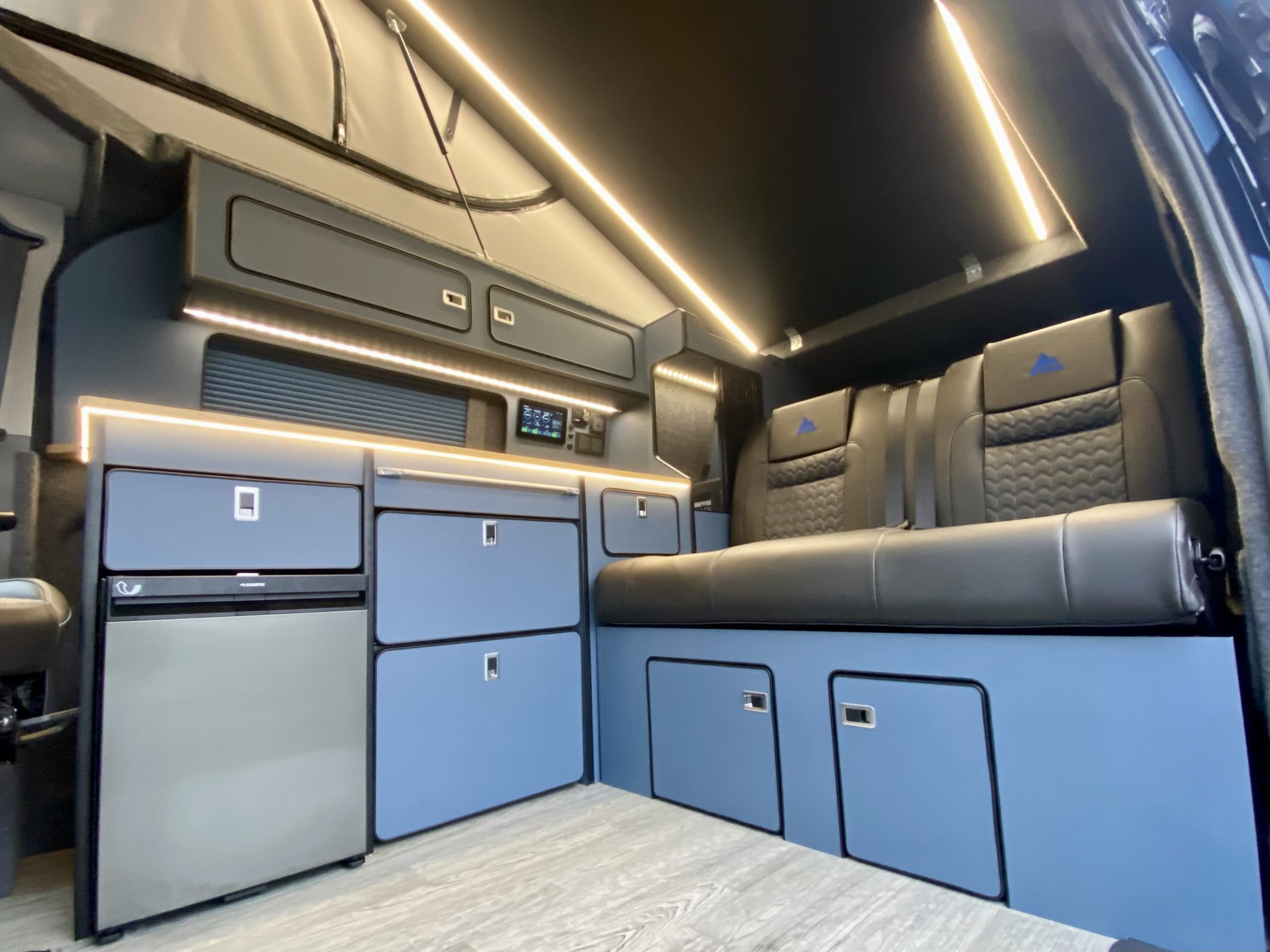
Most campervan conversions use a portable chemical toilet, and every van we build comes with a Thetford Porta Potti. In a 5 metre van there is very little space for a fixed washroom, and a portable toilet gives you what you need without giving up the kitchen or the bed. The other options are a cassette toilet, which is built in, and a separating or composting toilet, which uses no water or chemicals.
This guide compares all three, then covers the part people ask about most: where you can legally empty a campervan toilet.

Portable chemical toilets: the Porta Potti range
A portable camping toilet has two parts. The top tank holds the flush water and sits under the toilet seat, and the bottom tank holds the waste and unclips so you can carry it to a disposal point. Thetford’s Porta Potti (often spelt porta potty) is the best known range. These figures come from Thetford’s own specification sheet.
| Model | Waste tank | Flush water | Height | Flush | Waste gauge |
|---|---|---|---|---|---|
| Porta Potti 335 | 10 litres | 10 litres | 313mm | Piston pump | Yes |
| Porta Potti 145 | 12 litres | 15 litres | 330mm | Bellows | No |
| Porta Potti 345 | 12 litres | 15 litres | 330mm | Piston pump | Yes |
| Porta Potti 165 | 21 litres | 15 litres | 414mm | Bellows | No |
| Porta Potti 365 | 21 litres | 15 litres | 414mm | Piston pump | Yes |
| Porta Potti 565P | 21 litres | 15 litres | 448mm | Piston pump | Yes |
| Porta Potti 565E | 21 litres | 15 litres | 448mm | Electric | Yes |
Thetford calls the 335 the smallest toilet in its range, and it comes with a hold down kit as standard so it stays put on the road. The bigger 21 litre models need emptying less often but take more space and weigh more when full.
How often you need to empty it
Thetford’s advice is to empty the waste tank every 4 to 5 days, depending on the chemical additives you use, or sooner when the gauge turns red. It also says not to travel with the waste tank more than three quarters full, or with the flush tank more than half full. When you store the toilet, empty it, clean it, dry it and leave the blade open.
Cassette toilets
A cassette toilet is fixed in place, and its waste tank slides out through a hatch in the side of the vehicle. The Caravan and Motorhome Club describes it as accessible from its own exterior door, which you open to add fluid, fill the flush water and remove the cassette to empty it.
Thetford’s current cassette models hold between 17.5 and 19.3 litres of waste. The catch for a small van is that a cassette needs a fixed toilet space inside and a service door cut into the bodywork. That is why you mostly see them in motorhomes with a washroom, rather than in pop top van conversions.
Separating and composting toilets
Separating toilets, often sold as composting toilets, send liquid waste to a liquid container and solid waste to a separate solids container, and use no water or chemicals. Two examples:
- Thetford’s S220 separation toilet has a 7.0 litre solids container and a 7.5 litre liquid container, and needs a service door like a cassette.
- The Trelino Origin L holds 10 litres of each, weighs 6.8kg, and needs no water, chemicals or power.
Thetford says the urine can be poured into a normal toilet and the solid waste can go in household waste, and adds that you should always check local regulations. Trelino also directs solid waste to general household waste. The appeal is fewer trips to a disposal point. The downside is the price and, for some models, the need for a hatch in the bodywork.
Which chemicals to use in a camping toilet
The Caravan and Motorhome Club asks that all toilet fluids are biodegradable and that you avoid any product containing formaldehyde. The Camping and Caravanning Club says blue chemicals used to contain formaldehyde but that this is now rare. Sites that run on a septic tank may have strict rules on which chemicals they accept, so check before you arrive. Thetford says its green products are safe for septic tanks.
Where you can empty a campervan toilet
Only at a proper chemical disposal point, often called an Elsan point. You will find them on campsites, including every Caravan and Motorhome Club Certificated Location. The Camping and Caravanning Club says you must only empty a chemical toilet at a designated disposal area, never at a grey water point or near a fresh water supply.
Never empty one into a drain, a river or onto the ground. SEPA, Scotland’s environment regulator, says chemical toilet waste must never go into a burn, river, loch, surface drain, the sea or onto the ground. The Campervan and Motorhome Professional Association points out that dumping sewage waste into the environment is illegal and can lead to a fixed penalty or prosecution.
Does a portable toilet make your van self contained?
This matters if you want to use the overnight parking some councils offer to motorhomes. Cornwall Council, for example, allows overnight stays in 11 of its car parks only for vehicles that are self contained with their own toilet. Northumberland’s motorhome pilot defined self contained as having a toilet, sink and waste storage on board.
We have not found any official guidance that says whether a portable toilet counts. Check the signs at the car park or ask the council before you rely on it. Our Cornwall campervan itinerary lists the car parks.
What we fit
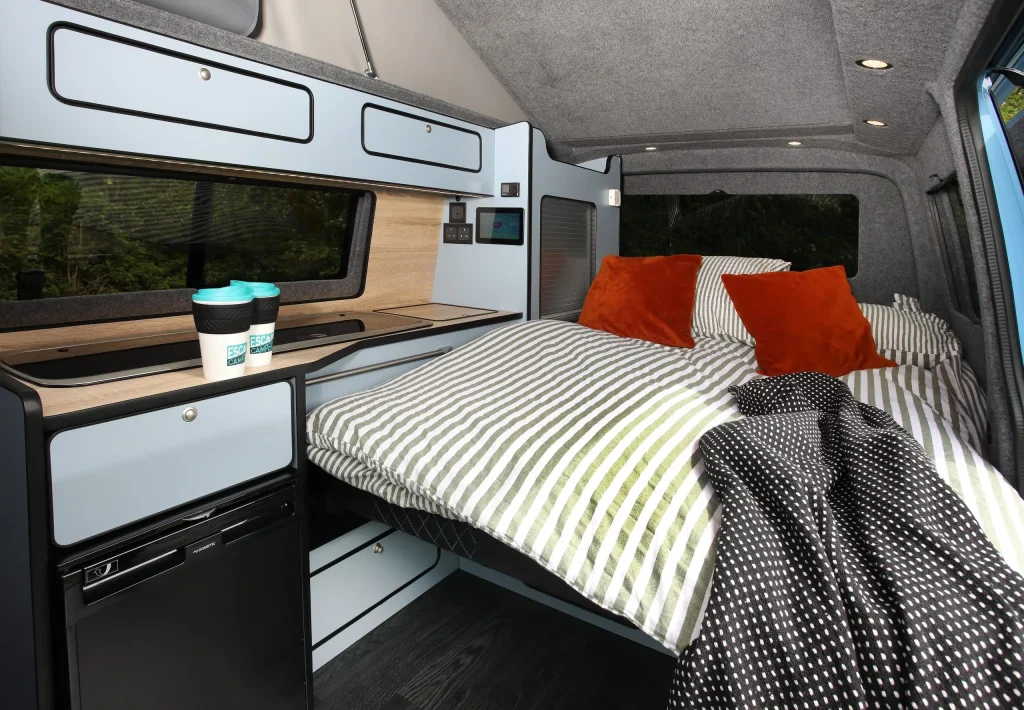
Every Escape build, the Crusader on the Renault Trafic, the Breeze Plus on the VW T7 and the Apex on the Ford Transit Custom, comes with a Porta Potti and a place to store it, plus an external shower point. We build pop top vans around a RIB seat bed and a proper kitchen, so a portable toilet is the right fit for the space. If a fixed washroom is essential for you, our guide to campervans against motorhomes explains the trade off, and our small campervan guide shows what fits in five metres.
See the current builds on our campervans for sale page, or call the workshop on 01733 639 206.
Questions we get asked
What is the best type of toilet for a campervan?
For most van conversions, a portable toilet such as a Porta Potti. It needs no hatch or fixed washroom and you can store it out of the way. A cassette or separating toilet makes more sense in a bigger van with a dedicated toilet space.
Is it worth having a toilet in a campervan?
For most people, yes. It makes night stops and sites without facilities far easier, and some council car parks only allow vans that are self contained with their own toilet.
How often do you need to empty a Porta Potti?
Thetford recommends every 4 to 5 days, depending on the additive, or when the level gauge turns red.
Where can I empty my campervan toilet?
Only at a chemical disposal point, usually called an Elsan point, such as those on campsites. Never into a drain, river or onto the ground.