

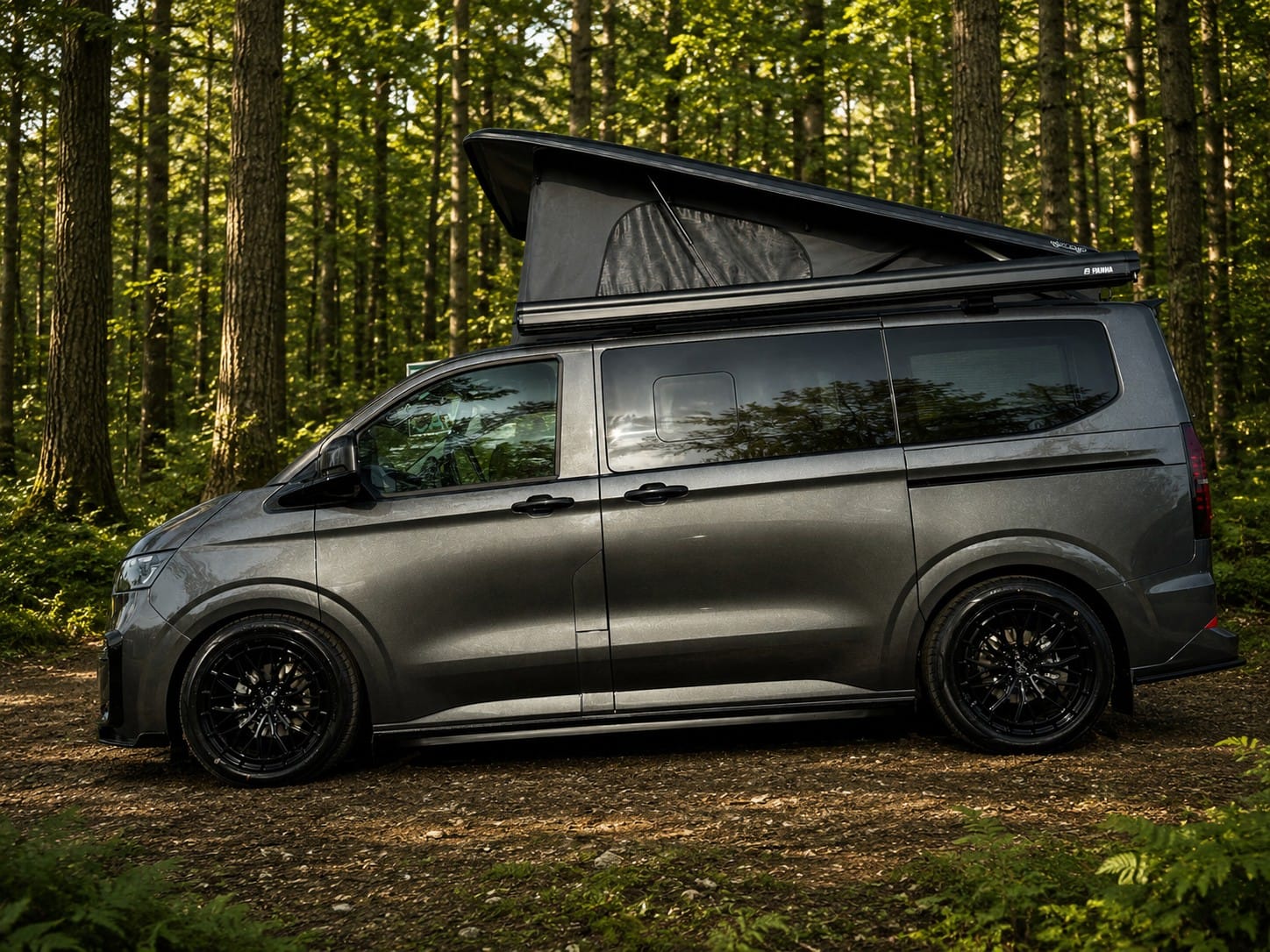
In the UK, a small campervan usually means a conversion on a mid size van such as the VW T7 Transporter, the Renault Trafic or the Ford Transit Custom. These vans are around 5 to 5.5 metres long, sit under 3.5 tonnes, and you can drive them on an ordinary car licence. Park one on your drive and it is still your everyday car on Monday morning.
Those are the three vans we build on, so this guide comes from the workshop floor. It covers the sizes, the licence rules, what fits inside, and the questions to ask before you buy.
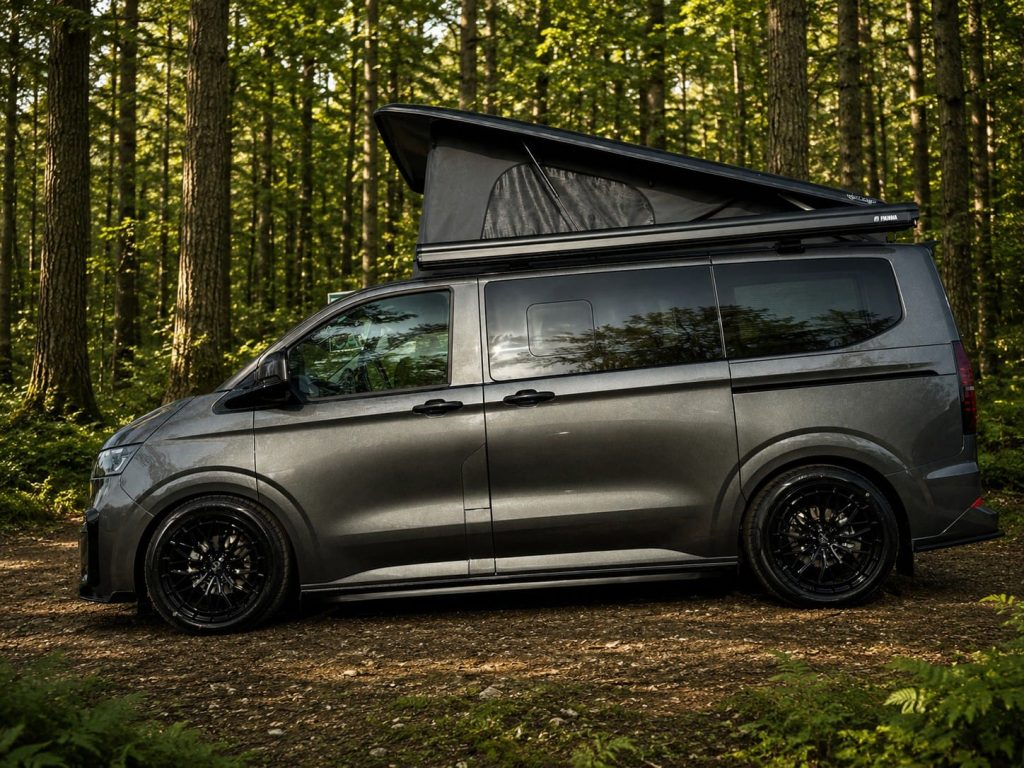
How big is a small campervan?
Here are the base vans before conversion, taken from the manufacturers’ own specification sheets. All are standard roof models.
| Van | Length | Height (standard roof) | Gross vehicle weight |
|---|---|---|---|
| VW T7 Transporter, short wheelbase | 5,050mm | Under 2.0m (VW) | 2,800 to 3,225kg |
| VW T7 Transporter, long wheelbase | 5,450mm | Under 2.0m (VW) | 2,800 to 3,225kg |
| Renault Trafic L1H1 | 5,102mm | 1,971mm | 3,010kg |
| Renault Trafic L2H1 | 5,502mm | 1,967mm | 3,070kg |
| Ford Transit Custom L1H1 | 5,050mm | 1,959 to 2,040mm | 2,825 to 3,225kg |
| Ford Transit Custom L2H1 | 5,450mm | 1,963 to 2,031mm | 2,825 to 3,225kg |
Sources: Volkswagen Transporter brochure, Renault Trafic technical specification, Ford Transit Custom brochure. Gross weights vary by engine and version.
The long wheelbase versions add 400mm. That is space for a longer kitchen, more storage or more floor between the seats. We compare the two in more detail in LWB against SWB campervans.
Will it fit in a car park?
Height is the first thing to check. Measure the finished van, not the brochure.
VW says the standard Transporter stays under 2.0 metres for multi storey car parks. But a campervan conversion with a pop top roof sits higher than the base van, even with the roof down. We have not found a published figure for a lowered pop top, so do not assume a converted van clears a 2.0 metre barrier.
For context, the Institution of Structural Engineers recommends at least 2.10 metres of headroom in car parks, with the height sign at the entrance usually set 50 to 100mm below the real clearance. Ask for the measured height of the van you are buying with the roof down, and keep it on a note on the dashboard.
Length matters too. The same guidance gives a preferred bay length of 4.80 metres, so even a short wheelbase van at 5,050mm will overhang a standard parking space slightly. A long wheelbase van overhangs by more.
Can I drive a small campervan on a car licence?
Yes, if the van is plated at 3,500kg or less. A category B licence covers vehicles up to 3,500kg maximum authorised mass, and that includes hybrids. Above 3,500kg you need category C1, which gov.uk says covers motorhomes up to 7,500kg. If you passed your test before 1 January 1997, you will usually have C1 already.
All the base vans in the table above are plated well under 3,500kg, so they sit comfortably in category B.
What fits inside five metres?
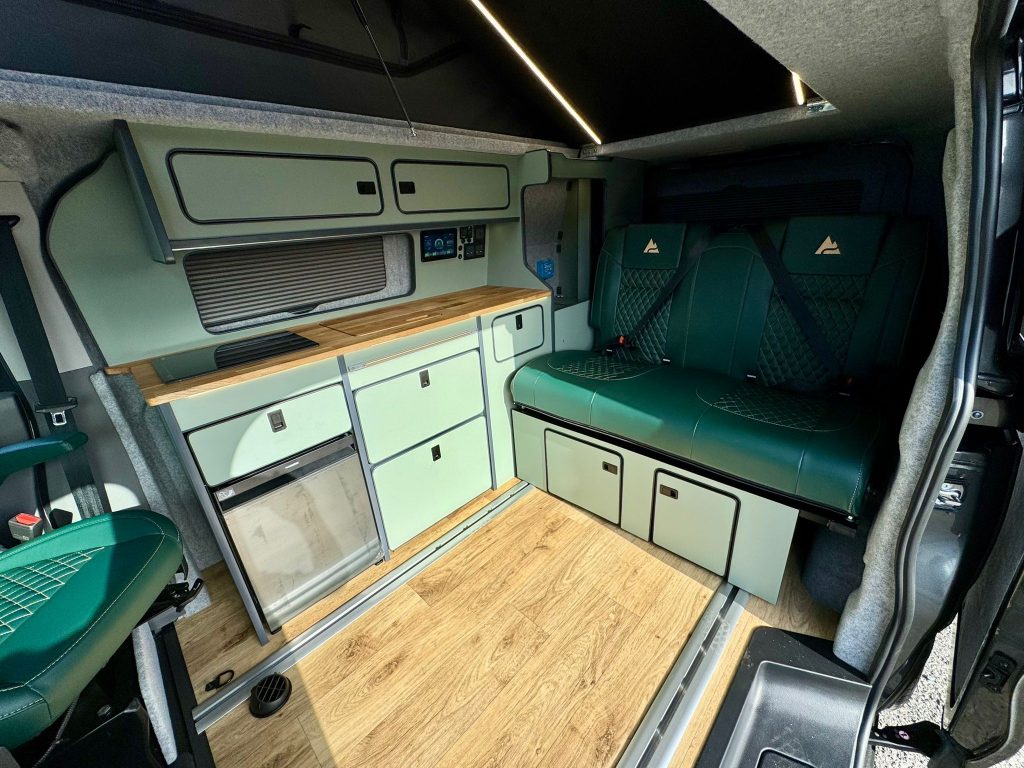
More than most people expect. A small van gives you a bed for two downstairs, another for two in the roof, a kitchen along one side and the power to live off grid between hook ups. What it does not give you is a fixed washroom. In our builds, that trade looks like this:
- A RIB seat bed that is a belted bench on the road and a double bed at night
- A pop top roof with a second bed
- A 50 litre fridge freezer, a hob, a sink and a water tank
- A Webasto diesel heater, a lithium leisure battery and solar charging
- An external shower point and a Porta Potti
Layout, storage and facilities
The classic small campervan layout puts the kitchen along the side opposite the sliding door, with the seat bed at the back and the cab seats turned round to face it. That layout gives you a lounge by day and two berths downstairs at night. Storage lives in the kitchen units, overhead lockers and under the seat bed, so pack light and put bulky camping gear on roof bars or a bike rack, both available as options on our builds.
Small campervan, micro camper or small motorhome?
Micro campers are built on smaller, car derived vans. They cost less and park like a car, but you get far less room: typically a bed and a basic kitchen, with nowhere to stand up. A mid size van with a pop up roof gives you standing room, a proper kitchen and space for up to four to sleep.
At the other end, if a washroom with a shower matters more than anything else, you are really shopping for a coachbuilt motorhome. These are built on a chassis with a wider, taller body behind the cab, which gives room for a washroom but makes them bigger to park and store.
A van conversion keeps the van’s own body. It is narrower and lower, drives like a large car, and is easier to park and store. You trade the washroom for a vehicle you can use every day. We cover the differences in our guide to campervans against motorhomes.
Which of the best small campervans suits you?
We build on all three base vehicles, and each has its own strengths.
- The VW T7 Breeze Plus has built up a real following among our customers. It comes as an automatic, in short or long wheelbase.
- The Renault Trafic Crusader uses the 170ps engine with a 9 speed automatic. We were the first UK converter to have our vehicles approved by Renault UK.
- The Ford Transit Custom Apex is built on the latest Transit Custom, including a plug in hybrid version if you want the option of electric running on shorter journeys.
Is a small campervan any good in winter?
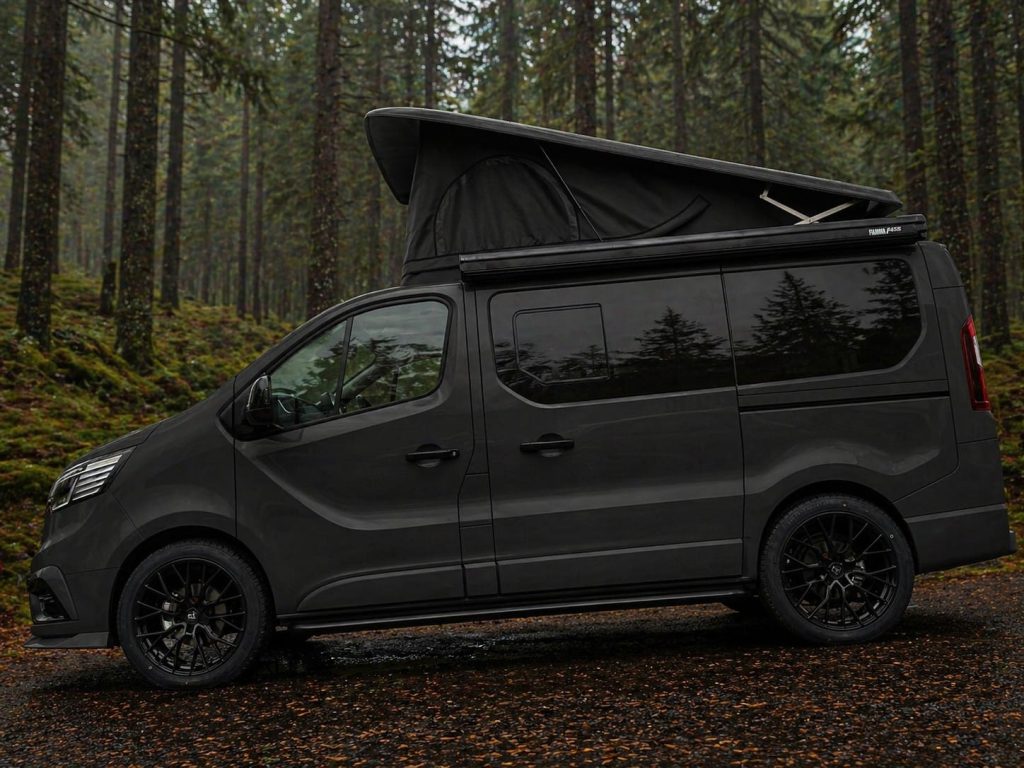
It can be, if the insulation and heating are right. Our vans are lined with Thermo-Liner insulation, the pop top has an insulated canvas, and every build has a Webasto diesel heater that runs from the van’s own fuel tank. Our diesel heater guide explains how that works and what a night of heat costs.
Five questions to ask before you buy
- What is the measured height with the pop top down?
- What does the finished van weigh on a weighbridge, and what is the plated gross weight? The difference is your payload.
- How many belted seats are there? Berths are not seats.
- Is the rear seat bed tested, and does the paperwork cover this van? Our guide to M1 tested rock and roll beds explains what to look for.
- What warranty covers the conversion? Ours comes with a 3 year conversion warranty. If you are comparing a professional build with DIY conversions, this is where the difference shows.
Price depends on the base vehicle, the wheelbase and the specification, so set your budget against the finished van, not the base van. See what we are building now, with prices, on our campervans for sale page, or call the workshop on 01733 639 206.
Questions we get asked
What is the best small campervan in the UK?
The one that fits how you will use it on UK roads. If it will be your only car, a short wheelbase van with an automatic gearbox is easiest to live with. If you tour for weeks at a time, the extra 400mm of a long wheelbase is worth having.
What is the smallest campervan with a toilet?
A portable toilet such as a Porta Potti fits in even a short wheelbase van, and ours come with one. A fixed washroom with a shower needs a larger van or a coachbuilt motorhome.
Do I need to tell the DVLA if I convert a van?
You can apply to have the body type changed to motor caravan if the van meets the DVLA’s criteria, which include how it looks from outside. A pop top does not count as a high top roof. Our campervan road tax guide explains the rules.
Which small campervan is the most reliable?
Start with a reliable base vehicle and a converter who stands behind the conversion. We look at the vans themselves in what are the most reliable vans for campervans.
Do I need a special licence for a small campervan?
No, as long as it is plated at 3,500kg or less. A standard category B car licence covers it.
How many people can sleep in a small campervan?
A pop top van usually sleeps four: two on the seat bed downstairs and two in the roof bed. Check how many belted seats it has for travelling too.

