

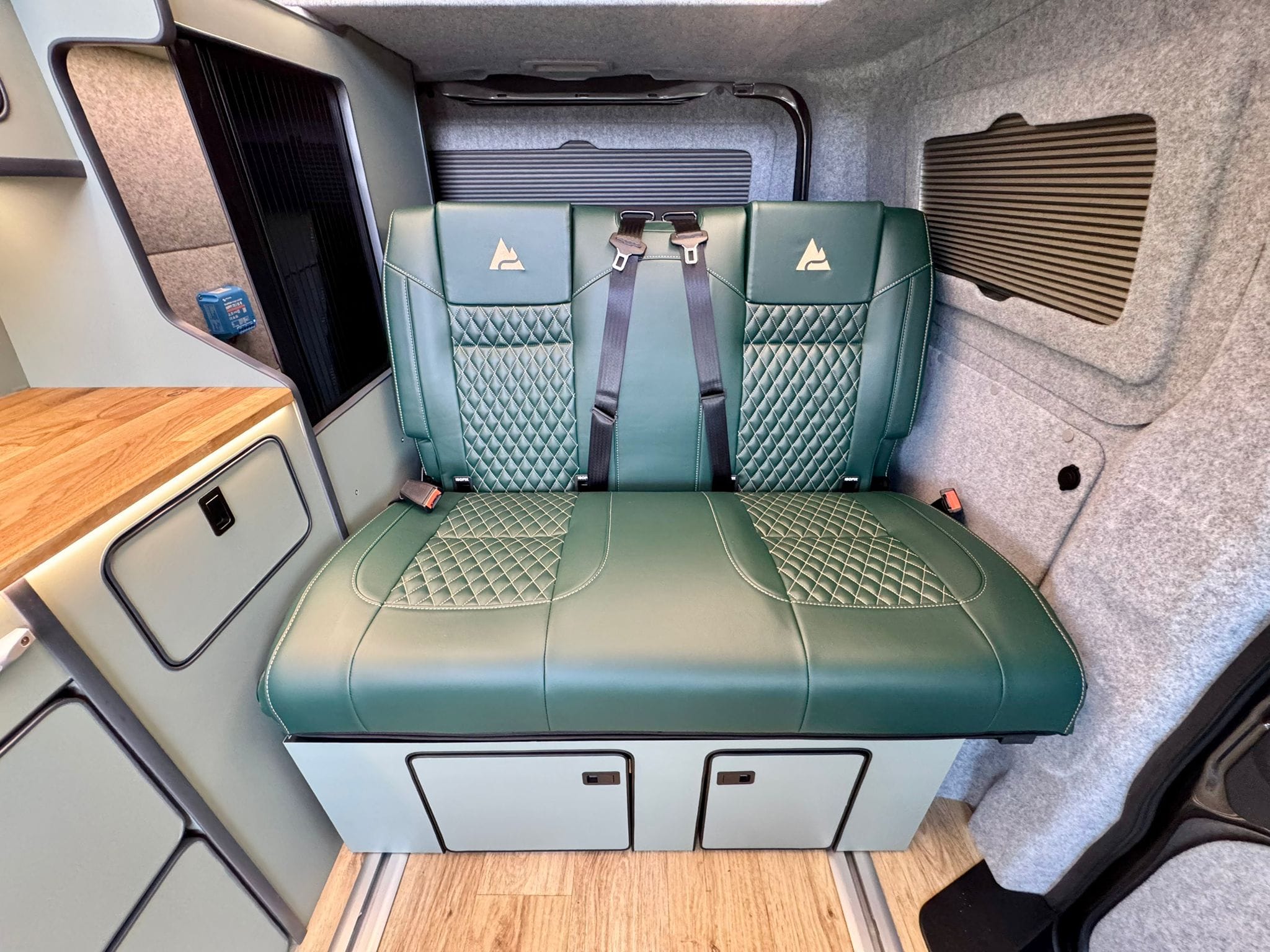
An M1 tested rock and roll bed (you will also see them sold as rock n roll beds) is a seat bed whose seat, belts and anchorages have been tested to the standards used for passenger cars. It is the bed your passengers sit on while you drive, so it has to hold them in a crash, not just fold flat at night. On a converted van it is not a legal requirement, which is exactly why you should know how to check it.
Every van we build has a RIB seat bed in the back and M1 tested swivel seating up front. This guide explains what the testing actually involves, where the law stands, and what to ask any converter before you hand over a deposit.
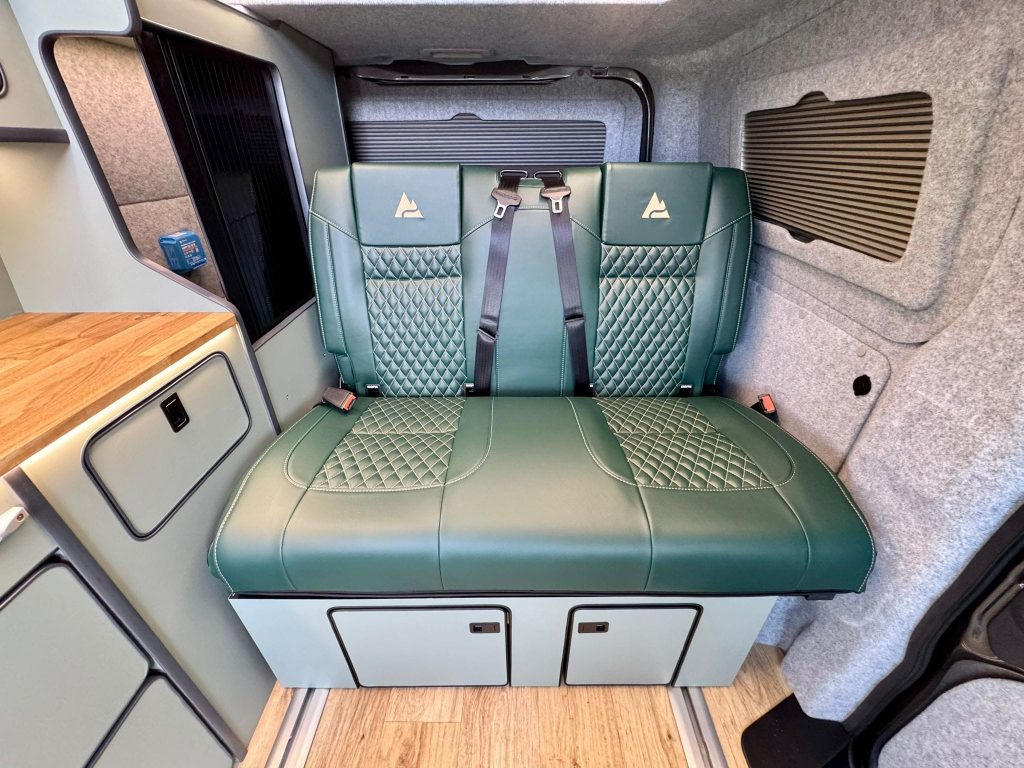
What does M1 actually mean?
M1 is a vehicle category, not a brand of test. The Vehicle Certification Agency defines it as vehicles used for carrying passengers with no more than eight seats in addition to the driver’s seat. In other words, cars, people carriers and motor caravans.
“M1 tested” is trade shorthand. It means the seat has been tested to the rules that apply to seats in that category. There are three that matter:
- UN Regulation 14 covers seat belt anchorages, the points the belts are fixed to.
- UN Regulation 16 covers the seat belts themselves.
- UN Regulation 17 covers the seats, their anchorages and any head restraints.
What the pull test does
The anchorage test in Regulation 14 is the one people mean when they say “pull tested”. The seat is bolted in, belts are fastened around body shaped blocks, and a rig pulls on the upper torso block and the lap block at the same time. For M1 vehicles the load is 1,350 daN on each block, and the anchorages must hold it for at least 0.2 seconds. That is 13.5 kN, or roughly 1.4 tonnes of pull on each block.
Where the belts are mounted on the seat itself, as they are on a rock and roll bed, the test adds a force equal to 20 times the mass of the complete seat. That makes sense. In a crash, a heavy bench full of storage and upholstery wants to keep moving too.
Regulation 17 tests the seat under a deceleration of at least 20g for 30 milliseconds. It also requires a head restraint on every outboard front seat in an M1 vehicle.
Is an M1 tested bed a legal requirement?
For a registered panel van converted into a campervan, no. The DVSA’s guidance on motor caravan construction requirements says conversions of registered panel vans are not affected by approval, and it calls the idea that crash tested beds or seats are required a misconception. It also says the converter must still produce a safe vehicle.
The picture changes for new motor caravans that go through type approval or Individual Vehicle Approval. There, every travel seat must be type approved, and that includes a seat that converts into a bed. Fixed beds need no test, but nobody should use them as a seat while the vehicle is moving.
Two more rules sit alongside this. Under UK seat belt law, you must wear a belt if one is fitted to the seat you are in, and only one person can use each belted seat. And a change of body type to motor caravan with the DVLA is about how the van is fitted out and how it looks. The DVLA says it does not change the insurance category or any other legal requirement, so a new logbook tells you nothing about the bed.
That is our reading of the published guidance, not legal advice. If you are unsure how your insurer views an untested bed, ask them before you buy.
Why the certificate only covers what was tested
A test proves one thing: that seat, on that base, fixed to that floor in that way, held the load. The DVSA’s own IVA paperwork treats the floor, seat and seat leg as one anchorage system and asks for test references for each, plus the tested limits such as leg height and seat weight.
So a certificate for a bed tested in one van is not proof it is safe in another. A bench tested on a bonded rail system in a VW T7 tells you very little about the same bench bolted through a different floor. Always ask whether the test covers your van model and the fixing method used in it.
Five things to check on any rock and roll bed
- Ask for the approval paperwork for the seat. Reputable makers supply it. Scopema, which makes RIB seat beds, says its dealers provide approval documents on request.
- Check the approval covers your van. Look for your make and model on the paperwork, not just “M1 tested” on a listing.
- Ask how it is fixed: bolted base, fixed rails or sliding rails, and whether the rails are bonded or bolted. It should match what was tested.
- Count the seatbelts, not the cushions. Each travelling passenger needs their own belted seat, with a head restraint.
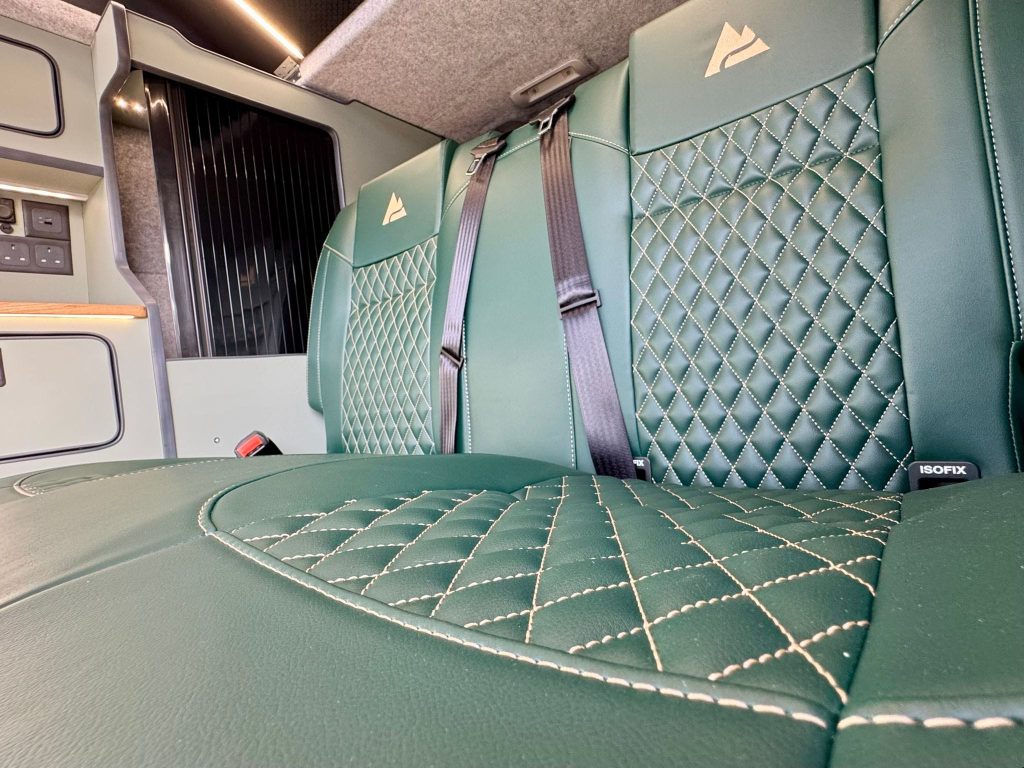
- If you carry children, check for ISOFIX or a top tether. Scopema says every 3 point bench it has shipped since 1 July 2023 comes with ISOFIX top tether.
If a converter cannot answer these clearly, that tells you something. Our checklist for buying a campervan covers the rest of the van.
Width and comfort matter too
Safety comes first, but you also sleep on this thing. Seat beds come in different widths: Scopema makes its two seat RIB bench in widths from 860mm to 1,200mm, for example. Check the bed width when it is folded flat, not just the seating, and lie on it before you buy. A good seat bed gives you a comfortable sleeping space and a safe seat from the same frame.
What we fit in our vans
Every Escape build, whether it is a Renault Trafic Crusader, a VW T7 Breeze Plus or a Ford Transit Custom Apex, has a RIB seat bed as standard. RIB is the brand of Scopema, a French seat maker that runs its own crash test centre and says its benches are tested in the presence of certification bodies such as UTAC. Scopema lists approvals for the Transit Custom, the Trafic and the T7, which are the three vans we build on.
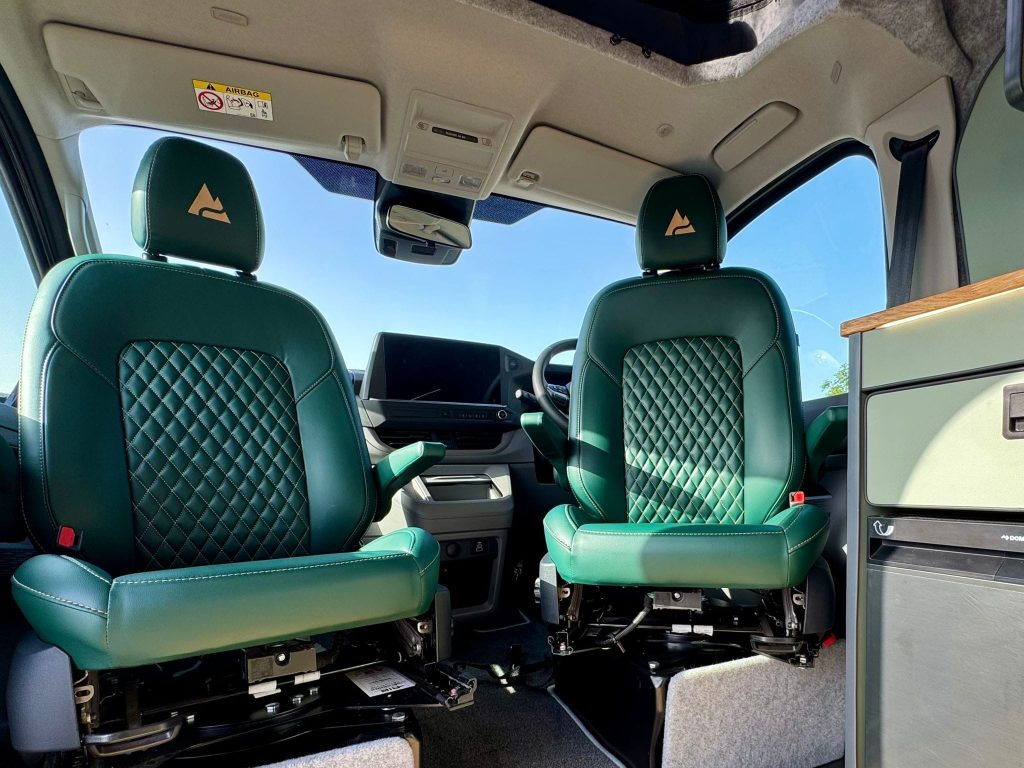
Up front, our builds have M1 tested swivel seating, so the cab turns into part of the living space when you stop. Every conversion also comes with our 3 year conversion warranty.
If you are looking at one of our vans, ask us which RIB bench and base it has, and for the approval paperwork that goes with it. You can see what is being built now on our campervans for sale page, or read how we put a van together on our process page.
Questions we get asked
Do I need an M1 tested rock and roll bed?
Not by law if your van was a registered panel van before conversion. But anyone sitting on that bed while you drive relies on it in a crash, so we would not buy a van without one.
What is the difference between M1 tested and crash tested?
“M1 tested” usually means the seat and anchorages passed the static pull test in UN Regulation 14. Regulation 17 adds a dynamic test at 20g. Ask the converter which tests the seat has passed and ask to see the paperwork.
Does the DVLA need to know about my bed?
No. When the DVLA decides whether to change a body type to motor caravan, it looks at the living features inside and how the van looks from outside. It does not check whether the bed was tested. It is worth knowing that a pop top roof does not count as a high top roof in its checklist.
Can I fit a rock and roll bed myself?
You can buy a seat bed with a fitting kit, but remember the test only covers the fixing method the maker tested. Follow the maker’s instructions exactly, use the specified fixings, and keep the paperwork. The DVSA is clear that whoever converts a van must produce a safe vehicle.
Can I use a rock and roll bed as a bed while driving?
No. It is a seat while the van moves, and passengers should sit on it belted in. The bed only comes out when you are parked.
Is a fixed bed safer than a rock and roll bed?
A fixed bed needs no test because nobody sits on it on the move. It also takes space you cannot use as seating. In a 5 metre van, a tested seat bed gives you more seats and more usable floor.

